
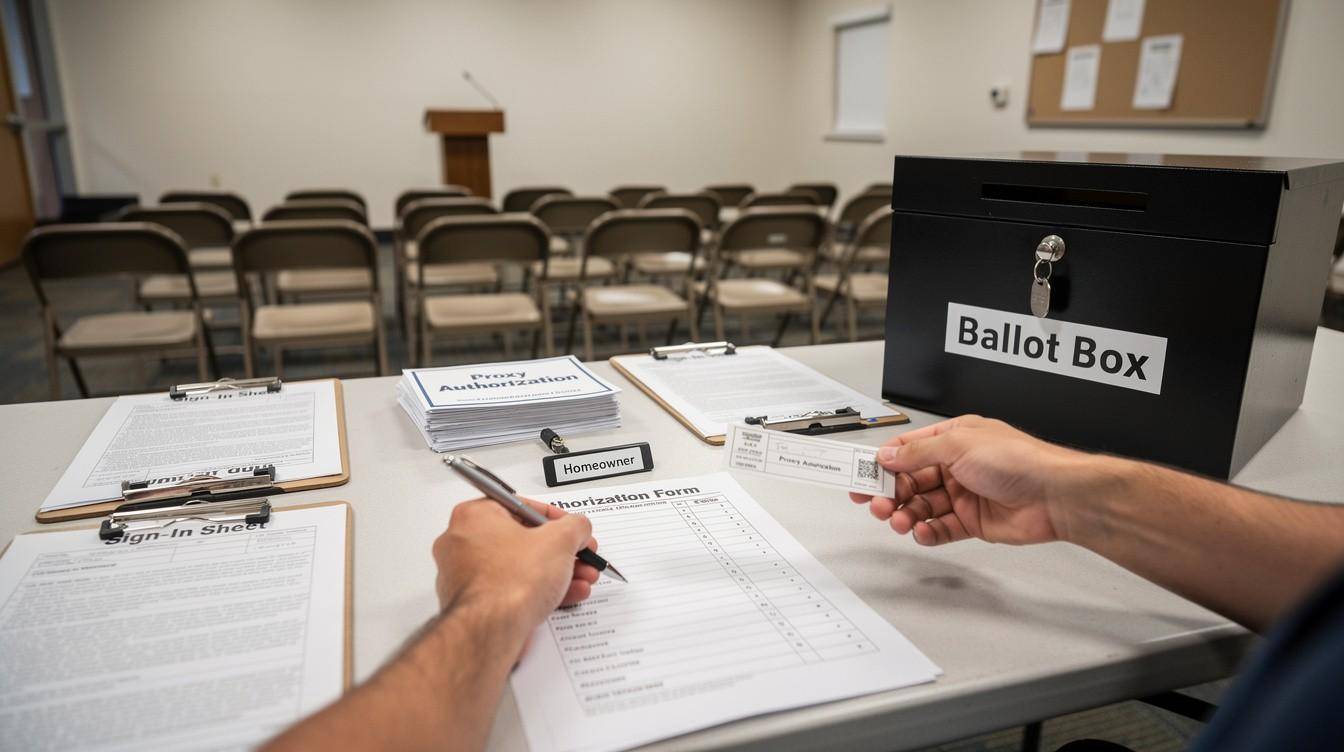
HOA elections often go wrong because boards and homeowners don’t understand proxy voting rights or follow the rules correctly. Improper proxy procedures can invalidate elections, trigger legal disputes, and damage trust within your community.
At Pratt & Associates, we’ve seen how getting proxy voting right protects your HOA from costly mistakes. This guide walks you through the legal requirements, common pitfalls, and practical steps to run clean elections.
How Proxy Voting Actually Works in Your HOA
A proxy is a written authorization that lets one person vote on behalf of another at an HOA meeting. The person giving the proxy is the principal, and the person voting is the proxy holder. This mechanism exists because not every homeowner can attend every meeting, yet every owner deserves a voice in major decisions like budget approvals, board elections, and architectural changes. The Uniform Common Interest Ownership Act, adopted in some form across most states, recognizes proxy voting as a standard right in homeowners associations. However, the specifics of how proxies function vary significantly based on your state’s laws and your HOA’s CC&Rs, which is where most problems start.
Understanding Your State’s Proxy Rules
Your state legislature has written specific rules about proxy voting that override general assumptions. California Civil Code Section 5100 requires that proxies be in writing and signed by the person authorizing them, and proxies cannot be held longer than three years. Florida Statutes Section 718.112 goes further, stating that proxies must be dated and cannot be used for more than one year or one meeting, whichever comes first. Texas Property Code Section 209.007 mandates that proxies be specific to each meeting and prohibits general proxies that cover multiple future votes. If your HOA operates in any of these states, using a proxy format designed for another state will likely result in invalid votes. Many boards fail at this basic step and later discover their election results are legally questionable because they ignored state requirements that were clearly documented.
CC&Rs and Board Rules Create Additional Requirements
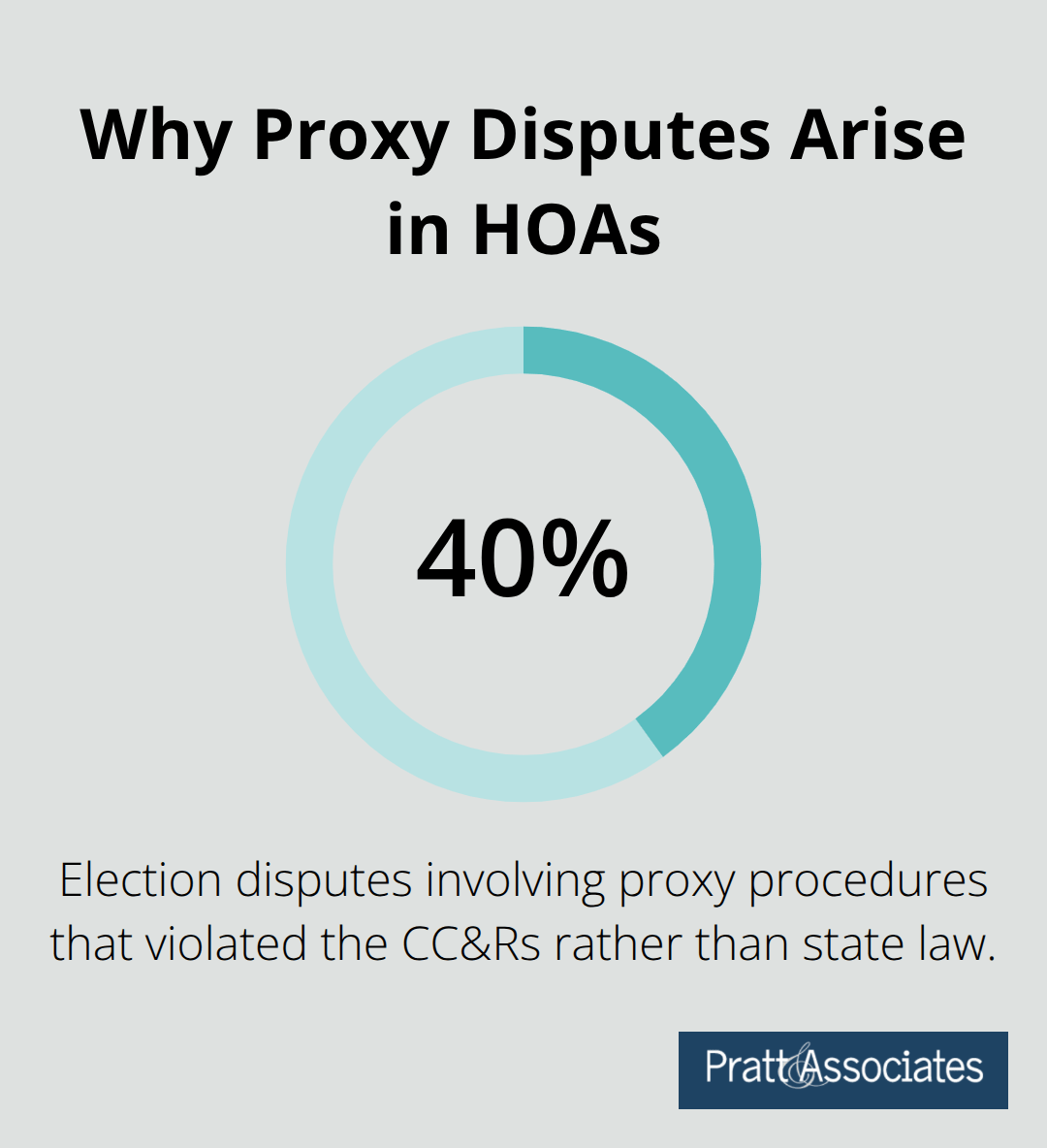
Your HOA’s CC&Rs and bylaws can impose stricter proxy rules than state law allows, but never looser ones. Some CC&Rs require that proxy holders be board members or officers, which significantly restricts who can accept proxies. Others prohibit proxies entirely for certain types of votes, such as special assessments or rule changes. Your declaration might specify that proxies must be notarized, delivered to the management company by a certain date, or limited to one proxy per person. If your CC&Rs say proxies must arrive ten days before the meeting and a homeowner submits one five days before, that proxy is invalid regardless of state law. We’ve reviewed hundreds of HOA election disputes, and roughly 40 percent involve proxy procedures that violated the CC&Rs rather than state law. The solution is straightforward: pull your CC&Rs and bylaws, read the proxy sections carefully, and compare them against your state statute. Document which rules are more restrictive and make that the standard your board follows.
If your CC&Rs are silent on proxies, state law fills the gap, but if they address proxies, they control.
What Happens When Proxy Rules Conflict
Conflicts between state law and CC&Rs create confusion that leads to invalid elections. A board member might assume that state law permits a certain proxy practice, only to find that the CC&Rs prohibit it. Another board might follow the CC&Rs strictly while ignoring a state statute that actually provides homeowners with additional rights. These conflicts can invalidate election results months or years after the vote occurred. The safest approach is to treat the most restrictive rule as your standard. If state law says proxies last three years but your CC&Rs say one year, use the one-year limit. If state law permits any homeowner to hold a proxy but your CC&Rs restrict it to board members, follow the board member restriction. This conservative approach protects your HOA from legal challenges and ensures that every proxy you accept will withstand scrutiny.
Where Proxy Problems Actually Happen
Proxy voting failures rarely stem from boards intentionally breaking rules. Instead, they happen because procedures are vague, communication is poor, or board members don’t understand what the law actually requires.
Improper Solicitation Practices
The most common problem is improper solicitation, where boards collect proxies without following the specific procedures outlined in state law or the CC&Rs. California Civil Code Section 5105 requires that proxy solicitations include specific disclosures about the meeting date, voting matters, and the proxy holder’s identity. If your board sends out a simple email asking homeowners to grant proxies without these details, those proxies are likely invalid. Florida and Texas have similarly strict requirements about what information must accompany proxy requests.
Many boards skip these disclosures entirely because they don’t realize the law mandates them. The fix is straightforward: create a standardized proxy solicitation form that includes every disclosure your state requires, have legal counsel review it once, and use that same form every year. This eliminates the guesswork and ensures compliance from the start.
Conflicts of Interest in Proxy Voting
Conflicts of interest represent the second major category of proxy problems, and they’re harder to spot because they often feel normal to boards that have operated for years without challenge. A board member collects proxies from homeowners, then votes those proxies at the meeting-this creates an obvious conflict. A property manager who accepts proxies and influences how they’re voted creates another.
Texas Property Code Section 209.009 actually prohibits certain people from serving as proxy holders specifically to prevent this issue. Even when state law doesn’t explicitly restrict proxy holders, your CC&Rs likely do. The practical reality is that concentrating voting power in the hands of board members or management corrupts the democratic process and invites legal challenges from homeowners who feel their votes were manipulated. The stronger approach is to restrict proxy voting to neutral parties or require that proxies be voted exactly as the homeowner specified in writing.
Validation and Documentation Failures
Invalid proxies and voting irregularities emerge when boards fail to validate proxies before accepting them. A proxy signed by someone who isn’t on the property deed, a proxy submitted after the deadline specified in the CC&Rs, or a proxy that violates the one-person-one-proxy rule should be rejected immediately. Document every rejection in writing and notify the homeowner why their proxy was invalid. This transparency prevents disputes and shows that your board took proxy compliance seriously.
Most election challenges succeed because boards accepted questionable proxies without documentation, then can’t explain their decisions months later when challenged. The board members who made those decisions have often moved on, leaving successors to defend indefensible choices. When a homeowner grants a proxy without specifying how to vote, that proxy should either be invalid or voted in favor of the board’s recommendations only if the proxy explicitly permits discretionary voting. This clarity protects both the homeowner and your HOA from future disputes.
The gap between what boards think they’re doing and what the law actually requires creates the conditions for election disputes. Understanding these three problem areas-solicitation, conflicts of interest, and validation-positions your board to prevent challenges before they start. The next section covers the specific procedures that protect your HOA and keep elections defensible.
How to Build a Proxy Voting System That Holds Up in Court
The difference between a defensible election and a legally vulnerable one comes down to whether your board implemented procedures that can withstand scrutiny. This means creating written proxy procedures that align with your state law and CC&Rs, then following those procedures consistently every single time. Start with a proxy procedures document that addresses every step from solicitation through vote counting. Your document should specify the exact format proxies must take, the deadline for submission, who can accept proxies, how proxies will be stored, and how they will be voted at the meeting. California HOAs typically require proxies to be signed and dated, with the meeting clearly identified. Florida HOAs must note that proxies expire after one year or one meeting. Texas HOAs need explicit language stating that each proxy applies only to the specified meeting. Once you have written your procedures, have a local attorney review them against your state statute and CC&Rs before you use them. This single step prevents months of disputes later. Then distribute your proxy procedures to every homeowner at least 30 days before any meeting where proxies will be accepted. Many boards fail to communicate procedures to the community, which means homeowners submit proxies in formats that violate your own rules. Post your procedures on your HOA website, include them in annual meeting notices, and reference them in every proxy solicitation you send out.
Your Proxy Form Must Match Your Legal Requirements
Create a standardized proxy form that your board uses for every election and every meeting. This form should include spaces for the homeowner’s name and address, the meeting date, the specific matters to be voted on, and instructions for how the proxy holder should vote. The form must be signed and dated by the homeowner, and ideally should include a statement that the homeowner understands they are giving up their right to vote at the meeting. If your state requires notarization, build that requirement into your form. If your CC&Rs limit who can hold proxies, add language stating that proxies can only be held by specified individuals or positions. Include a checkbox allowing the homeowner to either specify how their proxy should be voted or grant discretionary voting authority only if your CC&Rs explicitly permit this. Many boards use generic proxy forms downloaded from the internet, which creates compliance problems because those forms rarely address your specific state requirements or CC&Rs restrictions. Your management company should maintain copies of every proxy form ever used, organized by meeting date, so you can retrieve them if an election is challenged years later. Store originals in a secure location and create digital backups. If a homeowner later claims their proxy was misused or miscounted, you will have documentation proving exactly what authority they granted and how it was exercised.
Board Members and Staff Need Practical Training, Not Legal Lectures
Most proxy voting violations occur because board members and management staff do not understand what the law requires, not because they intentionally break rules. Your board should hold a training session at least annually that covers your specific state requirements, your CC&Rs proxy rules, and your HOA’s procedures. This training should be documented with attendance records and dates. During training, walk through a sample election scenario step by step. Show board members the exact proxy form they will use, explain the deadline for proxy submission, demonstrate how to validate each proxy against your requirements, and explain what happens when a proxy does not meet your standards. Use real examples from your own HOA rather than hypothetical situations. If your CC&Rs say proxies must be received by 5 p.m. three days before the meeting, explain that a proxy arriving at 5:01 p.m. is invalid and must be rejected. If your state law says proxies cannot be held by management company employees, explain that a proxy given to your management company’s office manager violates that requirement. Have your management company attend this training too, since they often handle proxy collection and storage. Assign one board member to serve as the proxy compliance officer for each election, responsible for validating proxies, documenting rejections, and ensuring procedures are followed. This concentrates accountability and eliminates the confusion that arises when multiple people handle proxies without clear authority or procedures. After the training, provide each board member with a written summary of your proxy rules and procedures to keep for reference.
Documentation Separates Defensible Elections from Vulnerable Ones
Document everything related to proxy voting before, during, and after your election. Create a proxy log that records the date each proxy was received, the homeowner who granted it, the proxy holder’s name, the meeting it applies to, and whether it was accepted or rejected. If you reject a proxy, document the specific reason it was invalid. Was it unsigned? Did it arrive after the deadline? Was the proxy holder prohibited by your CC&Rs? Was it the second proxy from the same homeowner? Write down the reason clearly. Send a written notice to any homeowner whose proxy was rejected, explaining specifically why their proxy did not meet your requirements and giving them an opportunity to submit a compliant proxy if time permits. At the meeting itself, maintain minutes that record how many proxies were received, how many were accepted, how many were rejected, and the total number of votes cast by proxy. Keep the original proxy documents in a secure file. If the election results are challenged, you will have a complete paper trail showing that your board followed procedures consistently and made defensible decisions about which proxies to accept. Elections challenged months or years later succeed when boards cannot produce documentation, fail when boards have clear records showing compliance. The documentation also protects future board members who will inherit your election files. If someone questions an election result from three years ago, your successors can review your proxy log and meeting minutes to understand exactly what happened and why your decisions were legally sound. This institutional memory prevents new boards from second-guessing prior decisions or making excuses for practices that violated your own procedures.
Final Thoughts
Proxy voting failures cost HOAs money, damage community trust, and create legal exposure that board members inherit for years. Getting proxy procedures right eliminates these risks entirely. When your board implements clear written procedures, uses standardized forms, validates every proxy against your state law and CC&Rs, and documents every decision, elections become defensible.
Homeowners who understand their proxy voting rights read the proxy procedures your board sends before submitting a proxy, follow the deadline, sign and date their proxy, and specify how they want their proxy voted rather than granting discretionary authority unless they fully trust the proxy holder. Board members who take proxy compliance seriously pull their state statute and CC&Rs today, identify which proxy rules apply to their HOA, create a standardized proxy form and procedures document that reflects those rules, and train their board and management company on those procedures annually.
If your HOA has never formalized proxy procedures or if your current procedures have not been reviewed by legal counsel in several years, contact Pratt & Associates to have your proxy procedures reviewed against your state law and your CC&Rs. A single legal review prevents costly election disputes and protects your community’s democratic process.