
Your HOA has significant power over your property and finances. Many homeowners don’t realize they have legal protections against unfair fees, selective rule enforcement, and restricted access to records.
At Pratt & Associates, we help homeowners understand their rights and fight back when associations overstep. This guide covers homeowner rights protection, from identifying violations to resolving disputes without court.
The Three Most Common HOA Violations Homeowners Face
HOA violations fall into three categories that appear repeatedly in homeowner disputes. Understanding these violations and your legal protections forms the foundation for defending your rights as a property owner.
Unlawful Fees and Special Assessments
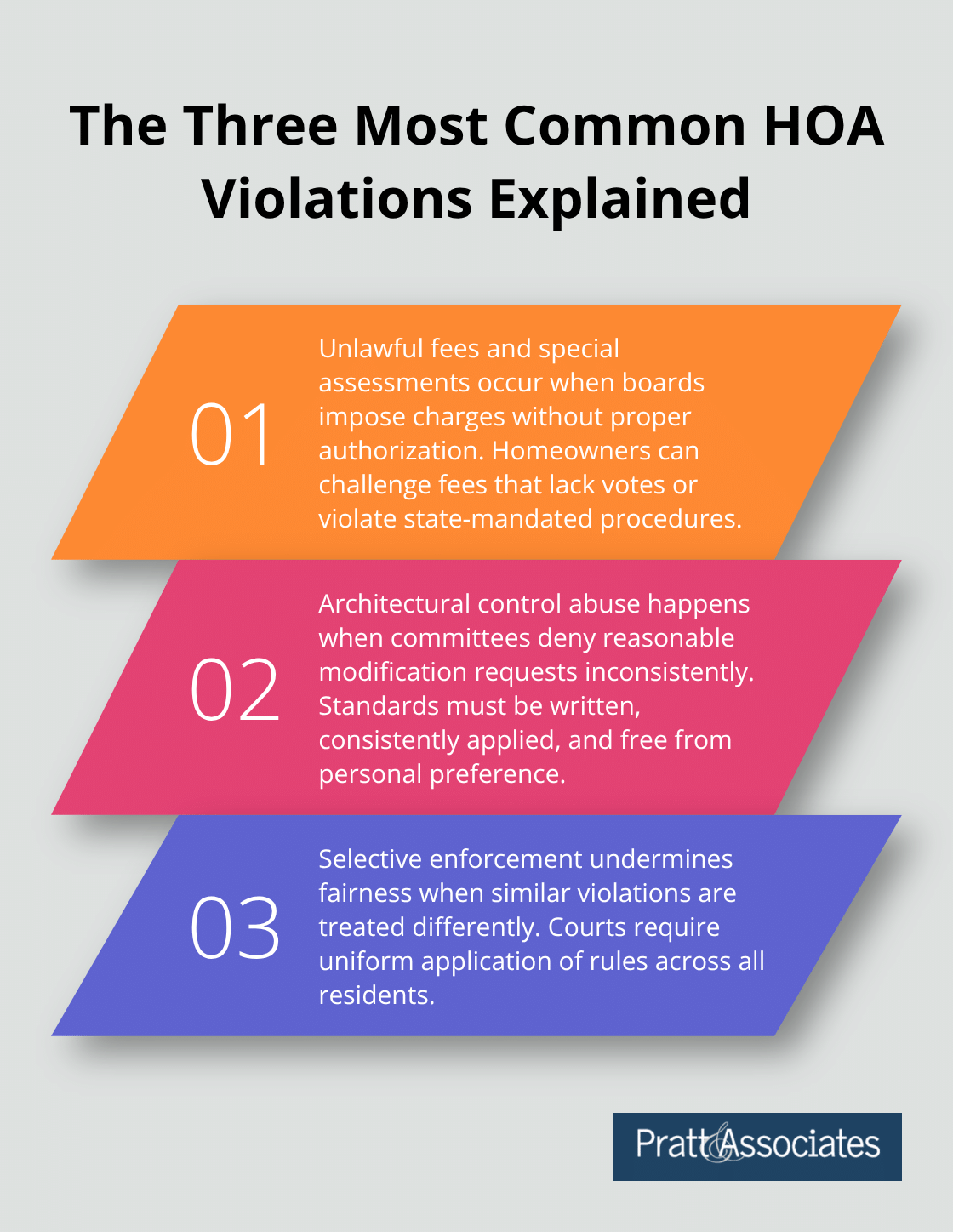
Unlawful fees represent the most frequent complaint homeowners bring forward. HOAs cannot charge special assessments without proper authorization in your CC&Rs or state law. California Civil Code Section 1366.4 specifically restricts surprise special assessments, yet many associations ignore this rule. If your HOA imposes a fee without a vote or without following state-mandated procedures, you have grounds to challenge it.
Many HOAs attempt to circumvent state regulations by categorizing illegal fees differently. A special assessment requires member approval in most states, but some boards call unauthorized charges maintenance fees or reserve contributions. Your CC&Rs define what fees the HOA can charge without a vote. If the board imposes anything beyond those authorized fees without proper procedures, challenge it immediately.
California requires HOAs to provide 30 days’ notice before collecting special assessments and must specify the exact amount and purpose. Document every communication about the fee. Request the board’s authorization records, meeting minutes, and the vote count. If the HOA cannot produce documentation showing proper authorization, you have a strong case against payment.
Architectural Control Abuse
Architectural control abuse occurs when HOA boards deny reasonable requests for home modifications without legitimate cause. The law requires architectural committees to apply standards consistently and reasonably. A board cannot reject your fence application while approving an identical fence for another homeowner.
Architectural committees must follow written guidelines consistently. If your CC&Rs require approval for exterior changes, the committee must evaluate all requests using the same standards. Many boards deny applications based on personal preference rather than documented architectural guidelines. Request the committee’s written standards in writing. Compare their decision on your application to similar approvals granted to other homeowners. If you find inconsistency, file a formal appeal with supporting documentation. Courts recognize that homeowners have a reasonable expectation that rules will be applied equally.
Selective Enforcement of Rules
Selective enforcement of rules is equally problematic and destroys community fairness. When an HOA enforces parking restrictions against you but ignores violations from board members, that’s illegal discrimination. Courts have consistently ruled that HOAs must apply rules uniformly across all residents.
If the HOA tolerates a board member’s landscaping violation while fining you for the identical issue, that’s actionable discrimination. Start by documenting violations you observe going unenforced. Take dated photographs and note which residents receive enforcement letters and which do not. Request the HOA’s enforcement records for the past three years. These records must show which violations were reported, investigated, and acted upon. Patterns of selective enforcement strengthen your legal position considerably.
Understanding these three violation categories positions you to recognize when your HOA has overstepped its authority. Once you identify a violation, your next step involves accessing the records and financial information that prove the HOA’s misconduct.
How to Access HOA Records and Financial Information
State Laws Mandate Document Disclosure
State laws give homeowners broad access to HOA documents, and most associations resist this requirement. California Civil Code Section 1365.2 mandates that HOAs provide members with financial records, meeting minutes, architectural decisions, and enforcement actions within 10 business days of a written request. Many boards ignore this timeline or claim documents don’t exist. They count on homeowners not knowing their legal rights. The reality is that your HOA must maintain these records and hand them over.
Submit Your Request in Writing
If your association delays beyond 10 days or refuses outright, that violation itself gives you grounds for legal action. Start with a formal written request sent via certified mail, not email. Email creates no paper trail and boards frequently claim they never received it. Your certified letter becomes evidence if you later need to prove the HOA violated state law.
Request Specific Documents That Prove Your Case
Financial records should include the HOA’s budget, reserve studies, all special assessment votes and authorizations, and payment records showing which homeowners paid disputed fees. Meeting minutes reveal whether the board followed proper procedures when voting on fees or architectural decisions. Request enforcement records for the past three years, including which violations were reported, who received violation notices, and what actions the board took. This documentation exposes selective enforcement patterns.
Understand What the HOA Cannot Withhold
Many boards claim they cannot provide certain records because they contain private information, but California law requires disclosure of most documents regardless. Your HOA cannot withhold financial records, board meeting minutes, or enforcement decisions to protect board members’ privacy. If the HOA refuses your request or provides incomplete documents within 10 days, send a follow-up certified letter stating that the violation of Section 1365.2 entitles you to recover attorney fees and court costs. Most associations comply immediately once they understand you know the law.
Build Your Documentation for the Next Step
If compliance still doesn’t happen, you have documentation proving willful violation. Courts take HOA non-compliance seriously because access to records forms the foundation of homeowner rights. Without these documents, you cannot prove unlawful fees, architectural abuse, or selective enforcement. Once you hold the records in hand, you can identify the specific violations and move toward resolution through mediation, complaints to state regulators, or formal demand letters.
Resolve HOA Disputes Without Court
Start with Direct Negotiation
Most homeowners assume they must file a lawsuit immediately after discovering an HOA violation, but this approach wastes time and money. Mediation and negotiation often resolve disputes faster and cheaper than litigation. Start with a meeting request to the HOA board to discuss your concerns directly. Bring your documentation from the records you obtained, including meeting minutes, financial statements, and enforcement records that support your position.
Many boards back down once they realize you have concrete evidence of their violations. Present your case calmly and factually, focusing on the specific violation rather than personal grievances. The board’s willingness to listen at this stage often signals whether resolution is possible without formal action.
Send a Formal Demand Letter
If the board refuses to meet or dismisses your concerns, send a formal demand letter via certified mail. Your letter should outline the violation, the harm it caused, and the specific action you require to resolve it. California Civil Code Section 1365.2 allows homeowners to recover attorney fees if the HOA violates record access requirements, so mention this in your letter.
The board’s response to your demand letter often determines whether you proceed to formal complaints or litigation. A well-documented demand letter (supported by the records you gathered) frequently prompts compliance because boards recognize the legal exposure they face.
File a Complaint with State Regulators
Filing a complaint with your state regulator applies additional pressure on non-compliant boards. California’s Department of Consumer Affairs handles HOA complaints, and many states have similar agencies. Submit a formal complaint that describes the violation, attaches copies of your documentation, and explains how the HOA’s conduct harmed you financially or legally.
State regulators investigate violations and can impose fines or require corrective action. This creates an official record of the HOA’s misconduct that strengthens your position in future disputes. Many boards comply after receiving notice of a state investigation because regulatory action damages their reputation and credibility.
Escalate to Legal Action When Necessary
If the HOA still refuses to resolve the dispute after mediation fails and state complaints are filed, you have exhausted reasonable alternatives and have built an ironclad case for court action. At this point, legal representation becomes valuable. Pratt & Associates can evaluate your case and help you pursue settlement negotiations or litigation with experienced guidance through the complex legal process.
Final Thoughts
You now understand the three most common HOA violations, how to access records that expose misconduct, and the dispute resolution steps that work before litigation becomes necessary. Homeowner rights protection requires action, not passive acceptance of unfair treatment. The violations we covered-unlawful fees, architectural control abuse, and selective enforcement-happen because boards assume homeowners won’t fight back.
Armed with knowledge of your legal protections and the documentation you can obtain, you shift the power dynamic significantly. If your HOA imposed an unauthorized fee, denied an architectural request inconsistently, or enforced rules selectively against you, start by requesting records immediately. Document everything in writing and keep copies, as most disputes resolve through direct negotiation or formal demand letters once the board realizes you understand the law and have evidence supporting your position.
Legal representation becomes necessary when the HOA refuses to respond to reasonable demands, continues violations despite your documentation, or the financial stakes justify professional guidance. Pratt & Associates handles HOA disputes and property litigation for homeowners facing unresponsive boards. Contact us to evaluate whether your case warrants settlement negotiations or court action.