

HOA boards in Santa Clara County face strict financial disclosure requirements under California law. Residents have the right to know exactly where their money goes, and boards that fail to provide clear financial information face serious consequences.
At Pratt & Associates, we’ve seen firsthand how transparency builds trust between boards and homeowners. This guide walks through what you must disclose, common mistakes to avoid, and how to stay compliant.
What Financial Information Must You Actually Disclose
California law requires HOA boards to provide residents with annual financial statements that show exactly where member fees go. These statements must include all revenues, expenses, and reserve fund allocations, broken down by category. The California Department of Consumer Affairs reports that boards must deliver these statements at least 30 days before the fiscal year ends or when the board approves the budget, whichever comes first.
Santa Clara County HOAs operating under the Davis-Stirling Common Interest Development Law must also provide a Reserve Funding Plan that details how the association plans to fund major repairs and replacements over the next 30 years. This is not optional paperwork-it is a legal requirement that protects homeowners from surprise special assessments. Many boards provide vague summaries instead of itemized breakdowns, but residents have the right to see specific line items for utilities, maintenance, insurance, and management fees. If your HOA spent $50,000 on roof repairs or $15,000 on legal services, those amounts must appear in your financial disclosures with enough detail that members understand the expenses.

Reserve Studies Require Current Data
Reserve studies are where most HOAs stumble. These assessments must evaluate the condition of common area components and estimate replacement costs based on current market prices. A reserve study conducted in 2019 is essentially worthless by 2026 because construction and material costs have shifted dramatically. Santa Clara County boards should update reserve studies every three years at minimum, though annual updates are increasingly necessary given inflation in construction costs.
The study must identify which components are approaching the end of their useful life and calculate how much money the association needs to set aside monthly to cover future replacements. Without accurate reserve data, boards cannot legally justify fee increases or special assessments, and residents have grounds to challenge any financial decisions that affect their monthly payments. The reserve study becomes the foundation for your entire financial disclosure strategy, so treating it as a checkbox exercise rather than a serious assessment of your community’s actual needs creates liability.
Fee Assessments Must Be Transparent and Justified
When your HOA increases regular assessments or levies special assessments, you cannot simply announce a number without documentation. California law requires boards to provide residents with a detailed explanation of why the increase is necessary, what it will fund, and how the amount was calculated. For regular assessment increases, boards must show how the new amount relates to the budget and reserve funding plan.
For special assessments (which Santa Clara County residents often challenge), the documentation must include the specific project or repair that triggered the increase, the total cost, and why the reserve fund cannot cover it. Many boards fail this requirement by providing only a percentage increase without the supporting financial analysis. Residents are entitled to see the actual bid proposals, repair estimates, or reserve study findings that justify the assessment. If your HOA cannot produce this documentation, the assessment itself becomes questionable and potentially unenforceable. Transparency here also reduces resident disputes-people accept financial decisions they understand far more readily than decisions that appear arbitrary.
These disclosure requirements form the backbone of HOA governance, but boards often overlook the specific mistakes that trigger compliance violations and resident complaints.
What Santa Clara County HOAs Must Disclose Under California Law
The Davis-Stirling Disclosure Requirements
California’s Davis-Stirling Common Interest Development Law sets the baseline for what every HOA in Santa Clara County must disclose to residents, and the requirements are more specific than most boards realize. The law mandates that HOAs provide annual financial statements showing all revenues and expenses, a Reserve Funding Plan projecting 30 years of major repairs, and detailed budgets broken down by category. However, Santa Clara County boards often misunderstand which documents residents can legally request and when.
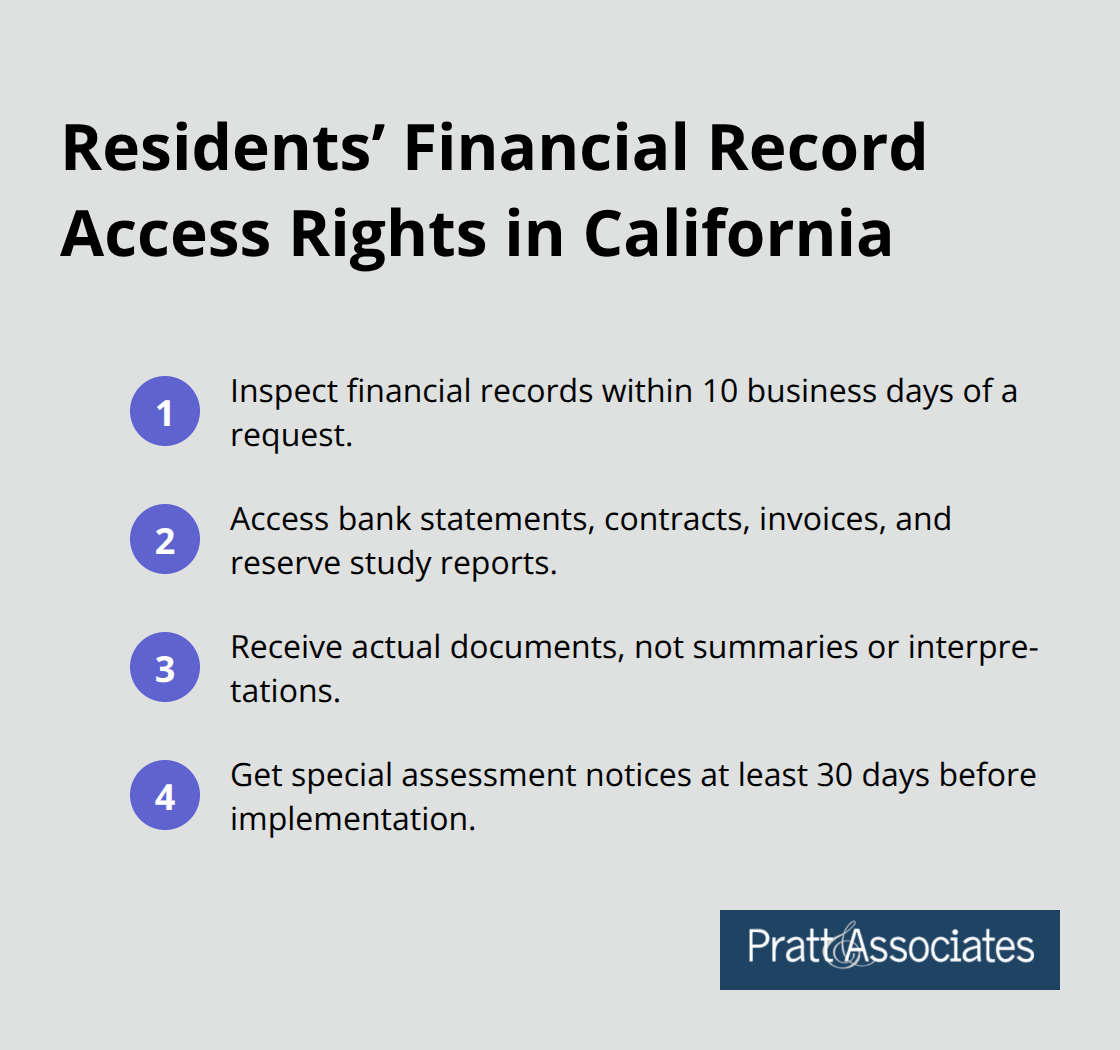
Residents have the right to inspect financial records within 10 business days of requesting them, according to California Civil Code Section 1365.2. This means your board cannot delay or refuse access to bank statements, contracts, invoices, or reserve study reports. Many boards incorrectly assume they can withhold certain documents or provide only summaries, but California law is clear: residents receive actual documents, not board interpretations of those documents.
What Documents Residents Can Access
The California Department of Consumer Affairs enforces these requirements, and violations result in fines, attorney fees paid by the association, and damage to your board’s credibility. Santa Clara County HOAs must also disclose special assessments at least 30 days before implementation, with full documentation of why the assessment is necessary and how the amount was calculated. Boards that provide incomplete reserve studies or refuse to update them create immediate legal exposure.
Penalties for Non-Compliance in Santa Clara County
The penalties for non-compliance are substantial enough that boards should treat disclosure requirements as non-negotiable. If your HOA fails to provide required financial statements, residents can file complaints with the California Department of Consumer Affairs, which has authority to investigate and impose penalties up to $5,000 per violation. Residents can also sue the association directly for breach of fiduciary duty, and courts regularly award attorney fees to winning homeowners in these cases.
Settlements in financial disclosure disputes often exceed $50,000 when cases reach litigation. The most common violation involves providing incomplete reserve studies or refusing to update them, which exposes the board to claims that special assessments were imposed without proper justification. Santa Clara County boards that delay disclosing special assessments, provide inaccurate financial data, or fail to maintain accessible records create legal exposure that extends beyond fines to potential personal liability for board members.
Building Trust Through Transparency
Treating transparency as standard practice rather than a compliance burden protects your association legally and dramatically reduces resident disputes. Boards that maintain clear financial records and communicate openly about expenses strengthen governance overall and avoid the costly litigation that follows disclosure failures. This foundation of trust becomes essential when boards must address the specific mistakes that most commonly trigger compliance violations.
Where HOA Boards Go Wrong With Financial Records
Santa Clara County boards consistently make three critical mistakes when handling financial disclosures, and each one exposes the association to legal liability and resident complaints.
Incomplete or Inaccurate Financial Reporting
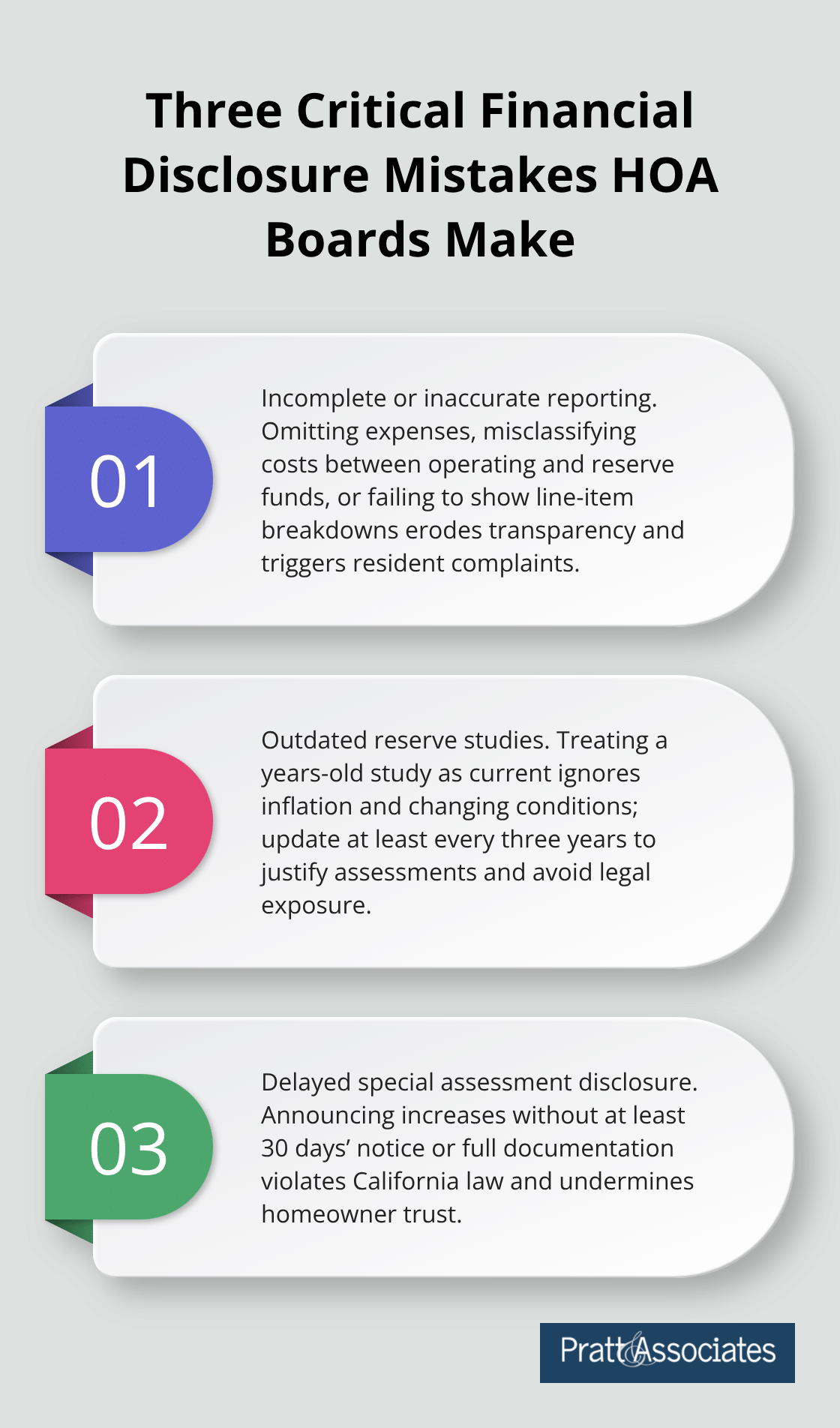
The first mistake is providing incomplete or inaccurate financial reporting. Many boards submit statements that omit significant expenses, misclassify costs between operating and reserve funds, or fail to show the actual breakdown of where member fees go.
California Civil Code Section 1365.2 requires that financial statements include all revenues and expenses with enough detail that residents understand exactly where their money goes.
When a board reports $2,000 monthly in miscellaneous expenses without itemizing what that covers, residents have legal grounds to demand detailed documentation. A proper statement lists utilities, maintenance, insurance, and management fees as separate line items so residents see precisely how the association spends their money. Vague categories invite scrutiny and complaints that could have been avoided with transparent reporting from the start.
Outdated Reserve Studies
The second mistake involves allowing reserve studies to become outdated. Boards often conduct a reserve study once, then treat it as permanent even as construction costs rise and building conditions change. A reserve study from 2020 is unreliable in 2026 given the significant inflation in labor and materials over the past six years.
Santa Clara County boards that fail to update reserve studies every three years cannot legally justify special assessments because they lack current data showing which components actually need funding. Construction costs have increased substantially since 2020, which means a reserve study from that period significantly underestimates what replacements will actually cost. Boards that rely on outdated assessments risk imposing special assessments that courts may later find unjustified.
Delayed Special Assessment Disclosure
The third mistake is delaying the disclosure of special assessments. California law requires boards to notify residents at least 30 days before implementing a special assessment, but many boards announce increases with insufficient notice or provide incomplete justification for why the money is needed. Residents who receive proper notice and full documentation (including repair estimates, reserve study findings, or bid proposals) accept assessments far more readily than those who face surprise announcements.
Financial and Legal Consequences
The financial damage from these mistakes compounds quickly. When boards fail to provide accurate statements, residents file complaints with the California Department of Consumer Affairs, which investigates violations and can impose penalties up to $5,000 per incident. Litigation over financial disclosure disputes regularly exceeds $50,000 in settlement costs, and courts award attorney fees to homeowners who win these cases.
Beyond the financial penalties, boards that mishandle disclosures face resident distrust that makes future governance decisions more difficult. The solution is treating financial transparency as a non-negotiable operational requirement, not a compliance checkbox. Boards should maintain itemized expense records, update reserve studies on a three-year cycle minimum, and provide special assessment notices with full supporting documentation at least 30 days before implementation. Residents accept fee increases far more readily when they understand the reasoning and see the actual numbers behind the decision. Santa Clara County boards that implement these practices eliminate the most common sources of compliance violations and reduce the likelihood of litigation that damages both finances and community relationships.
Final Thoughts
Santa Clara County HOA boards must treat financial disclosure requirements as the foundation of legal governance and community trust, not as bureaucratic obstacles. Your board’s obligation to provide annual financial statements, current reserve studies, and transparent special assessment documentation protects both the association and individual homeowners from financial disputes and litigation. Residents who understand the reasoning behind fee increases and see the actual numbers supporting financial decisions accept those decisions far more readily than those facing vague announcements or incomplete documentation.
Conduct an honest assessment of your current disclosure practices immediately. Review your most recent financial statements to confirm they include itemized line items for all major expense categories, check when your reserve study was last updated (if it’s older than three years, construction costs have shifted significantly since then), and establish a process for providing special assessment notices at least 30 days before implementation with complete documentation. Transparency also reduces the likelihood of costly litigation that can exceed $50,000 in settlement costs and attorney fees.
Pratt & Associates provides comprehensive legal services for real estate matters, including HOA governance and compliance issues. Their attorneys understand Santa Clara County’s specific regulatory environment and can help your board implement disclosure practices that protect the association while building resident trust.