

HOA conflicts can leave homeowners feeling powerless. The good news is that multiple legal remedies available can help you fight back against unfair decisions, excessive fees, or violations of your community’s governing documents.
At Pratt & Associates, we’ve seen homeowners win cases by understanding their rights and the options at their disposal. This guide walks you through the remedies you can pursue and how to navigate the legal process.
What Three Legal Remedies Actually Work Against HOAs
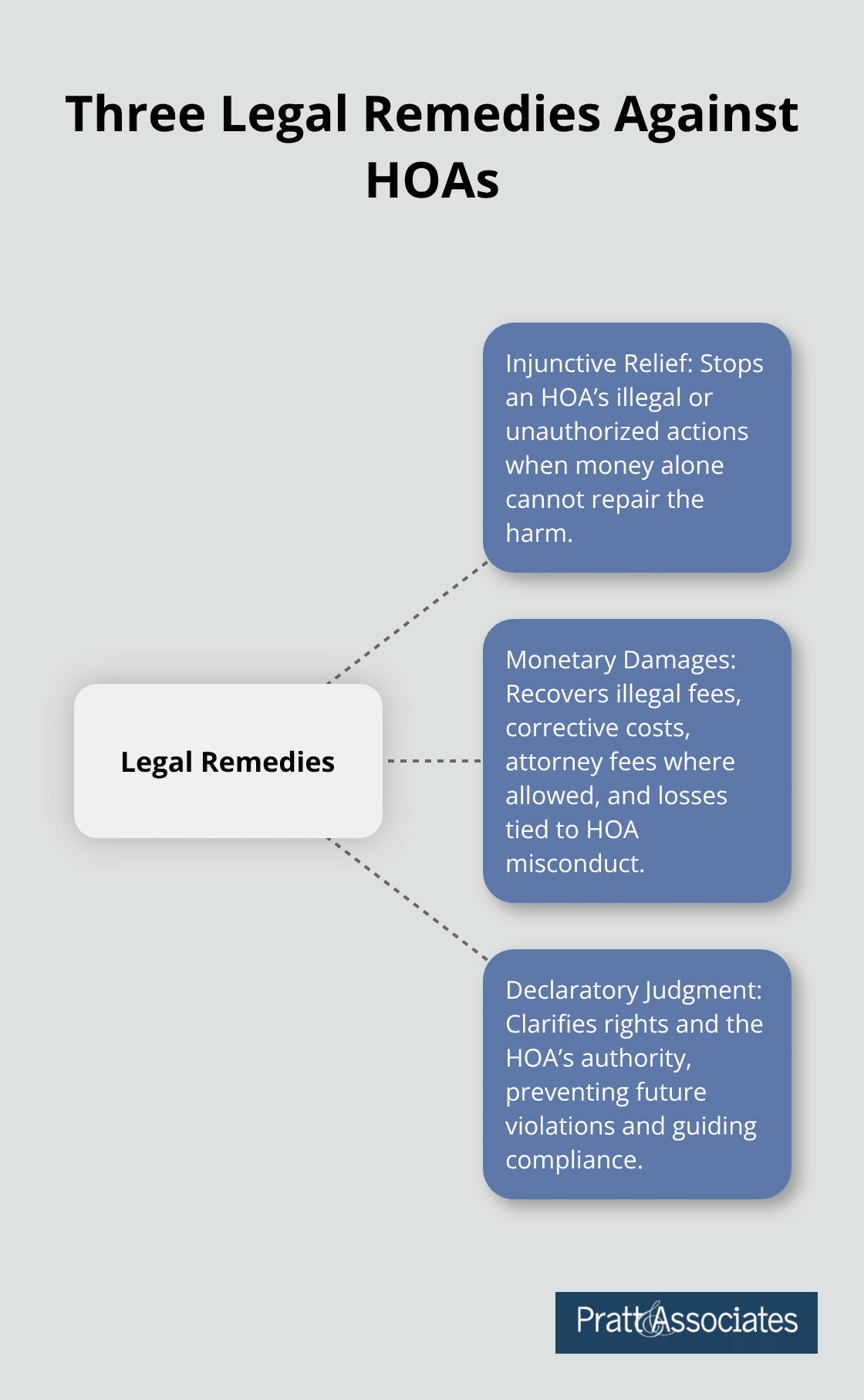
Homeowners facing HOA violations have three primary legal tools that courts recognize and enforce. Understanding which remedy applies to your situation determines whether you’ll stop the HOA’s action, recover money, or establish your rights going forward. Courts award these remedies based on the specific harm you’ve suffered and the nature of the violation.
Stopping Illegal HOA Actions Through Injunctive Relief
Injunctive relief halts an HOA from taking or continuing a specific action. Courts grant this remedy when a homeowner can prove the HOA’s action violates state law, the governing documents, or the HOA’s own bylaws, and that money damages alone won’t fix the problem. California courts regularly issue injunctions preventing HOAs from imposing improper fines, denying architectural approvals arbitrarily, or conducting meetings that violate open meeting requirements. To succeed, you must demonstrate irreparable harm-meaning the damage can’t be undone with a financial settlement.
If your HOA threatens to foreclose on your home for an illegal assessment, injunctive relief stops the foreclosure immediately. The California Department of Real Estate reported that improper fee increases represent one of the most common violations leading to successful injunction requests. Filing for an emergency or temporary restraining order can halt an HOA action within days while your full case proceeds, preventing irreversible consequences.
Recovering Financial Losses Through Monetary Damages
Monetary damages compensate you for actual financial losses caused by HOA misconduct. These include illegal fees paid, costs of correcting violations the HOA forced you to make, attorney fees in many California cases, and diminished property value resulting from the HOA’s actions. Courts award damages when the HOA acted outside its authority or violated state statutes governing homeowner associations.
California Civil Code Section 5975 allows homeowners to recover attorney fees when they prevail against an HOA in disputes over assessment validity, making litigation financially viable even in modest disputes. If an HOA illegally increased your assessment by $200 monthly for two years, you can recover the $4,800 plus legal costs. Some cases recover tens of thousands when HOAs wrongfully foreclose or impose assessments without proper procedures. Documentation matters critically here-keep records of every payment, communication, and expense related to the dispute.
Establishing Your Rights With Declaratory Judgments
A declaratory judgment asks a court to clarify what the law actually requires or prohibits regarding a specific HOA action. This remedy works when you need the court to interpret governing documents or determine whether the HOA has authority to take a particular action. If your HOA claims it can prohibit solar panels based on architectural guidelines, a declaratory judgment determines whether state solar rights laws override HOA restrictions.
California has strong solar protection statutes that limit HOA authority, and courts frequently issue declaratory judgments favoring homeowners in these cases. This remedy prevents future violations by establishing legal precedent within your community. Unlike damages, declaratory judgments don’t compensate past harm but instead clarify rights for ongoing protection. Many disputes combine declaratory judgments with injunctive relief-the court declares the HOA lacks authority and simultaneously orders the HOA to stop the illegal action.
Moving Forward With Your Remedy Strategy
Knowing which remedy fits your situation requires understanding the specific violation you’ve experienced. The next section examines common HOA disputes and shows which remedies courts have applied most successfully in each scenario.
Where Homeowners Win Against HOAs
Architectural Approval Denials: Your Strongest Battleground
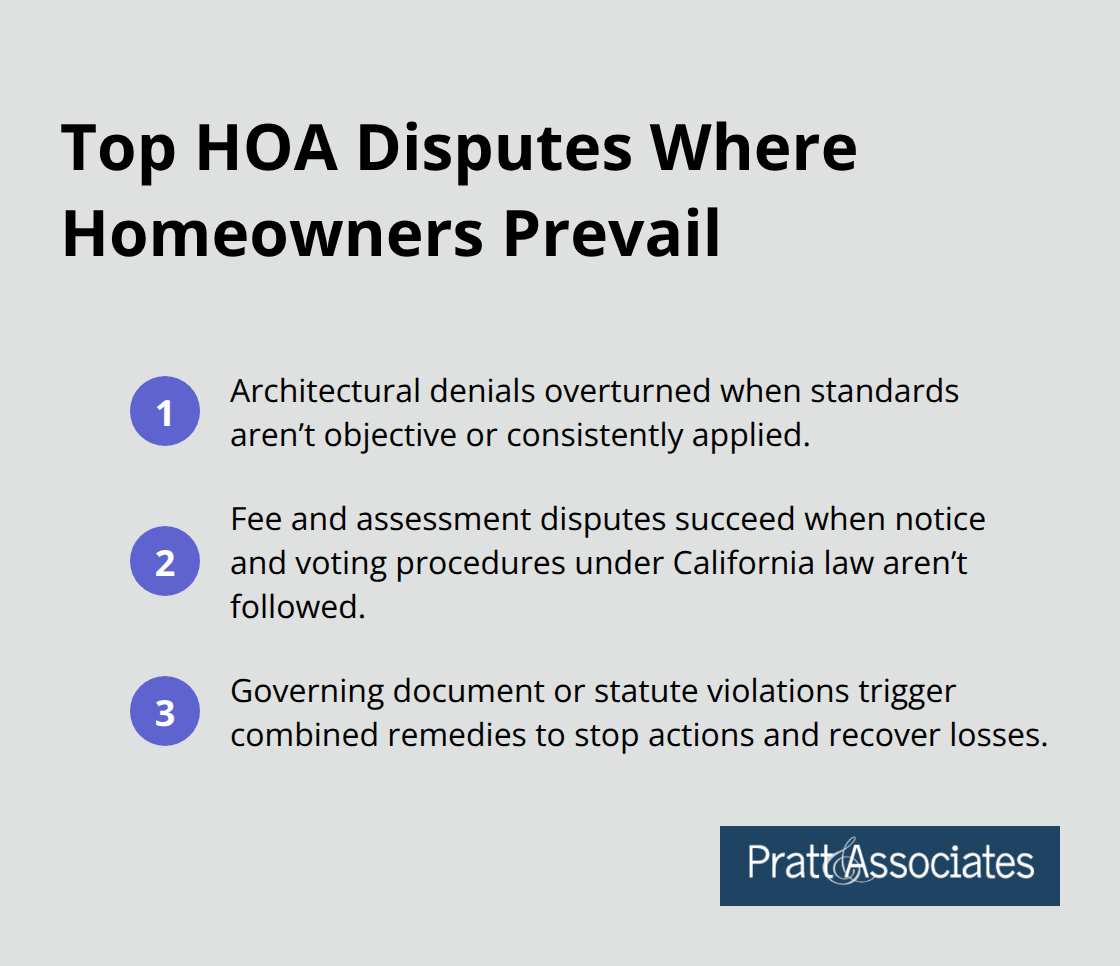
Architectural approval denials represent the battleground where homeowners most frequently prevail. HOAs often reject plans for exterior modifications, additions, or paint colors based on vague architectural guidelines that lack objective standards. California courts have consistently ruled that HOA architectural committees must apply standards consistently and cannot arbitrarily deny requests that comply with written guidelines.
If your HOA denied your request to install solar panels, replace a roof, or change exterior siding without providing specific written reasons tied to documented standards, you have strong grounds for injunctive relief. The remedy forces the HOA to either approve your project or provide detailed, objective justification for denial. Courts recognize that arbitrary architectural decisions cause irreparable harm because the denied improvement cannot be restored once the opportunity passes.
Document everything before filing. Photograph your property, compile the architectural guidelines, gather evidence of how the HOA approved similar projects for neighbors, and request written denial reasons in writing. This documentation transforms vague denials into provable violations that courts address through injunctive relief.
Fee Disputes: The Second Most Winnable Claims
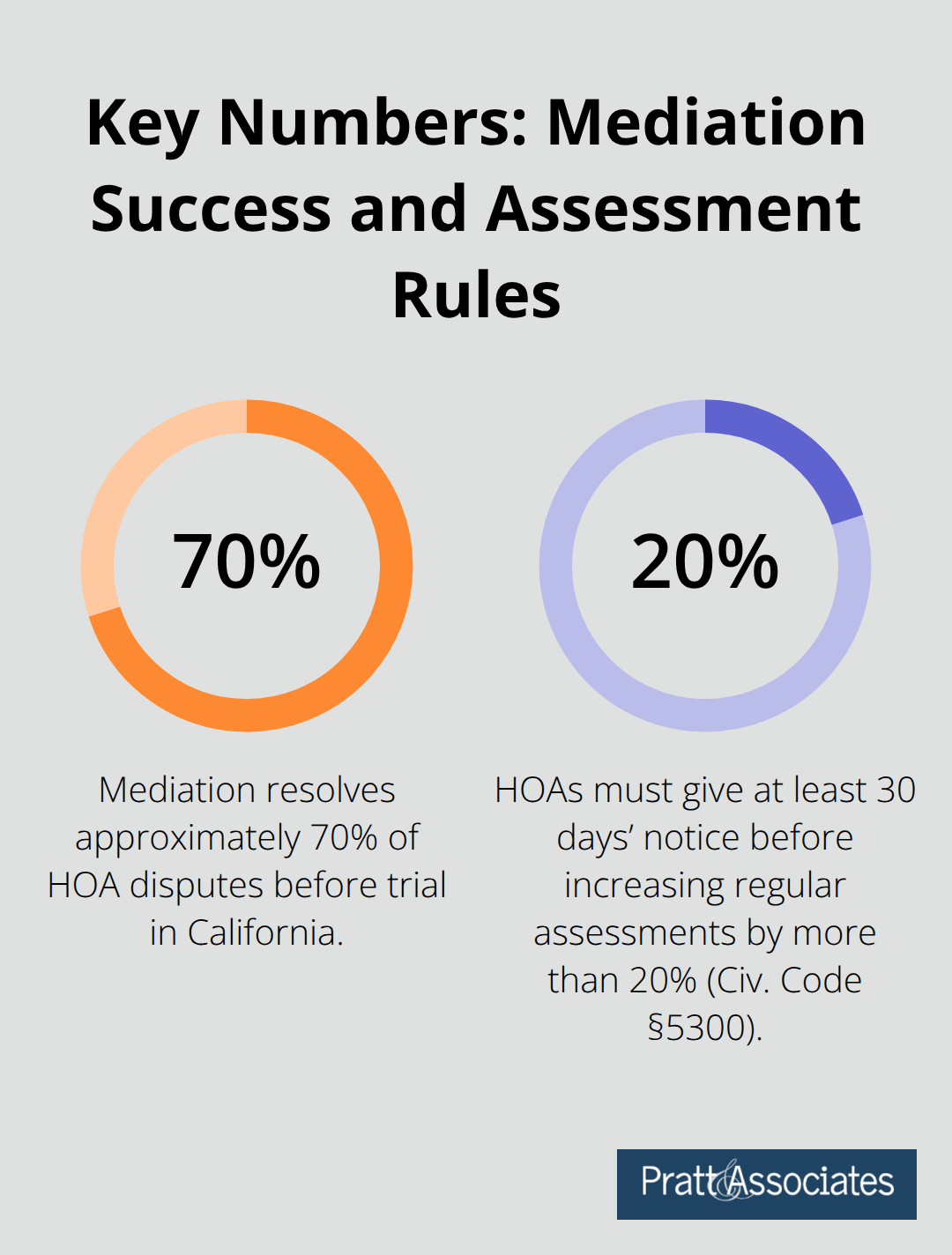
Fee disputes follow closely as the second most common successful claim. HOAs frequently increase assessments without proper notice, fail to follow voting procedures required by state law, or impose special assessments for projects that should fall under regular maintenance. California Civil Code Section 5300 requires HOAs to provide at least 30 days’ notice before increasing regular assessments by more than 20 percent, yet many associations ignore this requirement entirely.
When an HOA violates these procedural requirements, courts award monetary damages covering the illegal fees plus attorney fees under Section 5975, making litigation economically sensible. The key involves responding quickly-most statutes of limitations for assessment challenges run three to four years from the violation date, but early action strengthens your position. Keep detailed records of every assessment notice, payment confirmation, and communication with the HOA regarding fees.
Violations of Governing Documents and State Statutes
Violations of governing documents and state statutes round out the winning cases. If your CC&Rs prohibit the HOA from restricting certain activities but the HOA imposes fines anyway, or if the HOA conducts meetings without proper open meeting law compliance, declaratory judgments establish that the HOA lacks authority. These cases combine all three remedies: courts declare the HOA’s action invalid, issue injunctions stopping further violations, and award damages for past harm.
The strongest cases involve written proof of the violation. Email communications showing the HOA knew about the governing document language, meeting minutes demonstrating procedural violations, or assessment notices that contradict state law requirements all provide concrete evidence. Courts favor homeowners who present clear documentation that the HOA acted outside its authority or violated established procedures.
Building Your Case for Legal Action
Gathering evidence before you file determines whether you succeed or struggle through litigation. The next section explains how to navigate the legal process itself, from filing complaints with state agencies through preparing for court proceedings.
How to Navigate the Legal Process Against Your HOA
File a Formal Demand Letter First
Before you file anything in court, you need to understand that most HOA disputes follow a predictable path, and moving too quickly without proper groundwork weakens your position significantly. California requires homeowners to exhaust specific administrative remedies before litigation in many cases, which means filing complaints with state agencies first isn’t optional-it’s a strategic necessity that strengthens your legal standing.
Start by sending a formal demand letter to your HOA detailing the specific violation, the governing document or state statute violated, and the remedy you’re requesting. This letter should reference exact sections of California Civil Code and your CC&Rs, not vague complaints about unfairness. Keep copies of everything-the demand letter, the HOA’s response, and any communications that follow.
File Complaints With State Regulatory Agencies
The California Department of Real Estate’s Homeowner Bill of Rights mandates that HOAs follow strict procedures for assessments and violations, and documenting the HOA’s failure to follow these procedures at the administrative level creates the evidence courts need to rule in your favor. The California Department of Real Estate maintains an online complaint system where you can file formal grievances against HOAs that violate state law, and filing there creates an official record that demonstrates you pursued administrative remedies before court action.
This administrative step matters more than most homeowners realize. Courts view homeowners who filed complaints with state agencies as having acted reasonably and in good faith, which influences how judges evaluate your case.
Pursue Mediation and Arbitration Before Litigation
Many homeowners mistakenly skip mediation and head straight to litigation, but mediation resolves approximately 70 percent of HOA disputes before they reach trial, saving thousands in legal fees. California law allows both parties to request binding arbitration for assessment disputes under Civil Code Section 5965, which means a neutral third party hears the case outside of court and issues a binding decision.
Arbitration typically costs between $2,000 and $5,000 total compared to litigation costs that routinely exceed $15,000 to $25,000. This cost difference alone justifies attempting arbitration first. If mediation or arbitration fails and you proceed to litigation, you’ll have demonstrated to the court that you acted reasonably by attempting resolution outside the courtroom.
Prepare Your Evidence for Court Proceedings
If you proceed to litigation, your attorney will file a complaint in civil court specifying which remedy you’re pursuing-injunctive relief, monetary damages, or declaratory judgment. At this stage, discovery begins, where both sides exchange documents and depositions. Your attorney will request the HOA’s meeting minutes, financial records, architectural guidelines, and communications regarding your specific dispute.
Courts rarely side with HOAs that cannot produce documented justification for their actions during discovery, so the HOA’s failure to maintain proper records often leads to summary judgment in your favor before trial. Organize all your evidence chronologically, create a timeline of events, and identify any witnesses who can testify about the HOA’s conduct or the impact on your property. This preparation transforms scattered documents into a compelling narrative that courts understand and act upon.
Final Thoughts
You now understand the three primary legal remedies available to homeowners facing HOA violations: injunctive relief stops illegal actions, monetary damages recover your financial losses, and declaratory judgments establish your rights going forward. These remedies work because they address the specific harms you’ve suffered and force HOAs to operate within the boundaries of state law and governing documents. Most HOA disputes stem from associations that either misunderstand their authority or deliberately exceed it, which means knowing which remedy applies to your situation allows you to respond strategically rather than emotionally.
Architectural denials, improper fee increases, and violations of governing documents represent the disputes where homeowners most frequently prevail, but only when they document violations thoroughly and pursue remedies through proper channels. The legal process itself follows a predictable sequence: send a formal demand letter, file complaints with state regulatory agencies, attempt mediation or arbitration, and proceed to litigation only when necessary. This progression strengthens your position because courts recognize homeowners who acted reasonably and exhausted administrative options before filing suit, and most disputes resolve during mediation or arbitration while saving you thousands in legal fees.
We at Pratt & Associates help homeowners navigate HOA disputes by identifying which remedies available apply to their situations and building cases with the documentation courts require. Your next step depends on your specific situation-if you’re facing an architectural denial, gather documentation showing how the HOA approved similar projects for neighbors, and if you’re disputing fees, compile assessment notices and verify whether the HOA followed proper notice and voting procedures. Contact us to discuss your specific dispute and determine your path forward.