
HOA boards have significant power to maintain community standards, but that power comes with legal boundaries. Understanding enforcement procedures is essential for both board members and residents in Santa Clara County.
At Pratt & Associates, we help homeowners and associations navigate these complex rules. This guide breaks down how HOAs legally enforce community standards and what happens when residents don’t comply.
How HOAs Put Rules Into Practice
The Legal Foundation for Enforcement
Santa Clara County HOAs operate within a strict legal framework that requires clear documentation before any enforcement action can occur. California law mandates that HOAs establish their governing documents-typically the CC&Rs, bylaws, and architectural guidelines-before they can legally enforce any community standards. These documents form the foundation for every fine, lien, or legal action an HOA pursues. Without properly recorded and distributed governing documents, an HOA’s enforcement efforts collapse in court. Boards often attempt to enforce rules that weren’t properly documented or communicated to residents, resulting in costly legal defeats.
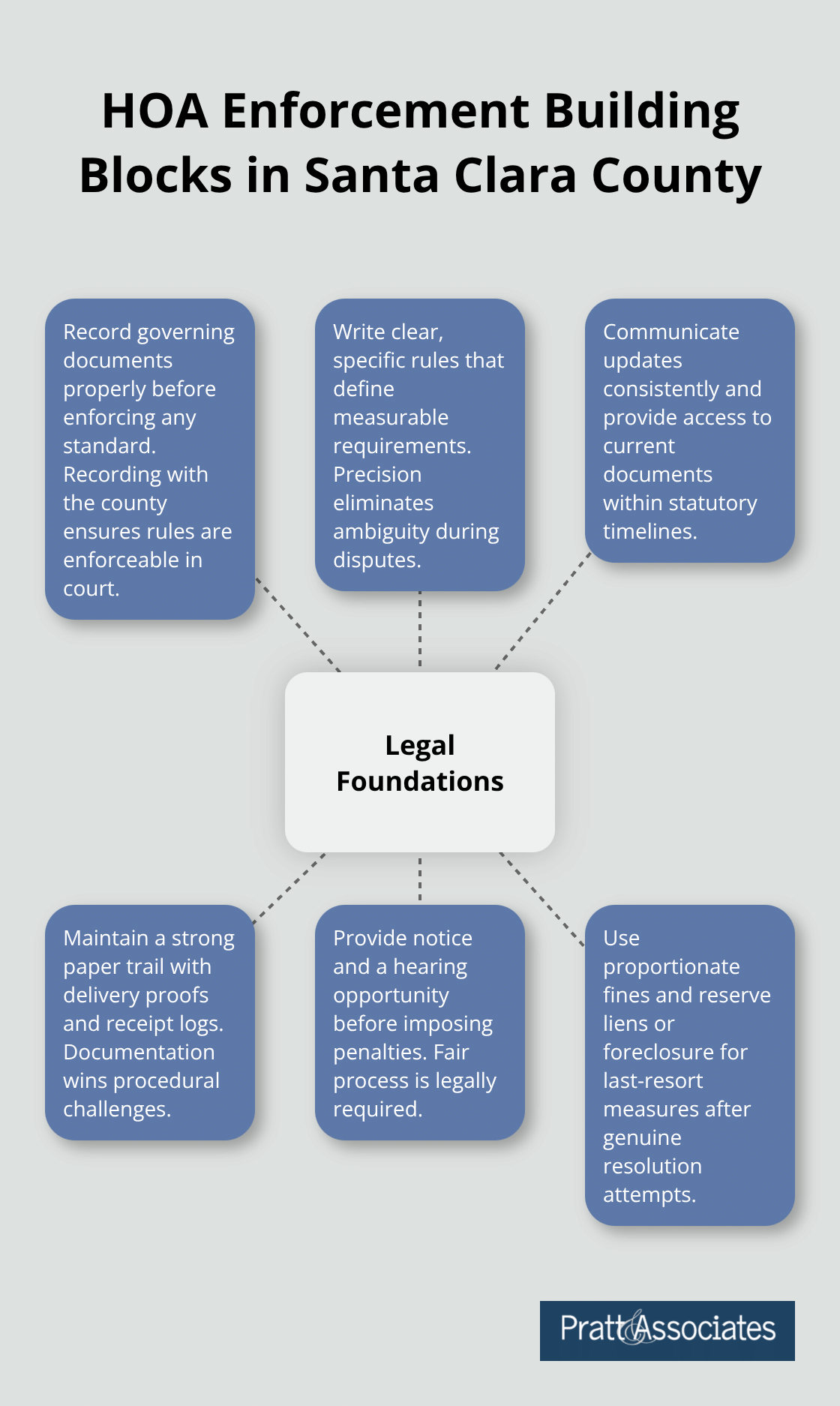
The CC&Rs must be recorded with the county recorder’s office in Santa Clara County to carry legal weight.
Communicating Rules to Residents
Many boards assume residents know the rules simply because they received documents at closing, but California law requires ongoing communication. The HOA must provide copies of current governing documents to residents within 10 days of a written request, per California Civil Code Section 1365. When an HOA updates rules, those changes must follow specific procedures-typically requiring board approval and sometimes member votes depending on what the existing bylaws specify. The HOA handbook should be comprehensive and updated annually, containing not just rules but the specific consequences for violations.
Writing Rules That Hold Up in Court
Vague language in governing documents undermines enforcement; a rule stating that yards must be maintained is weaker than one specifying lawn height cannot exceed three inches or that dead plants must be removed within 30 days. HOAs should distribute updated handbooks every two years and maintain a log showing when each resident received copies. Email delivery combined with certified mail creates a paper trail that holds up if enforcement disputes reach court. Residents who claim they never received notice of a rule change have a legitimate legal defense, which is why documentation of communication matters as much as the rules themselves.
Once an HOA establishes clear, well-documented rules and communicates them properly, the board can move forward with enforcement mechanisms when violations occur.
What Tools Do HOAs Use to Enforce Rules
The Violation Notice: Your First Line of Defense
Once an HOA has documented rules and communicated them to residents, enforcement begins with the violation notice. California law requires HOAs to send a preliminary notice before imposing any financial penalty, and Santa Clara County boards must follow this requirement strictly. The notice must describe the violation with specificity, cite the governing document section being violated, and provide a reasonable timeframe for the resident to cure the violation or request a hearing. Most boards allow 30 days before escalating to fines, though the CC&Rs may specify a different period.
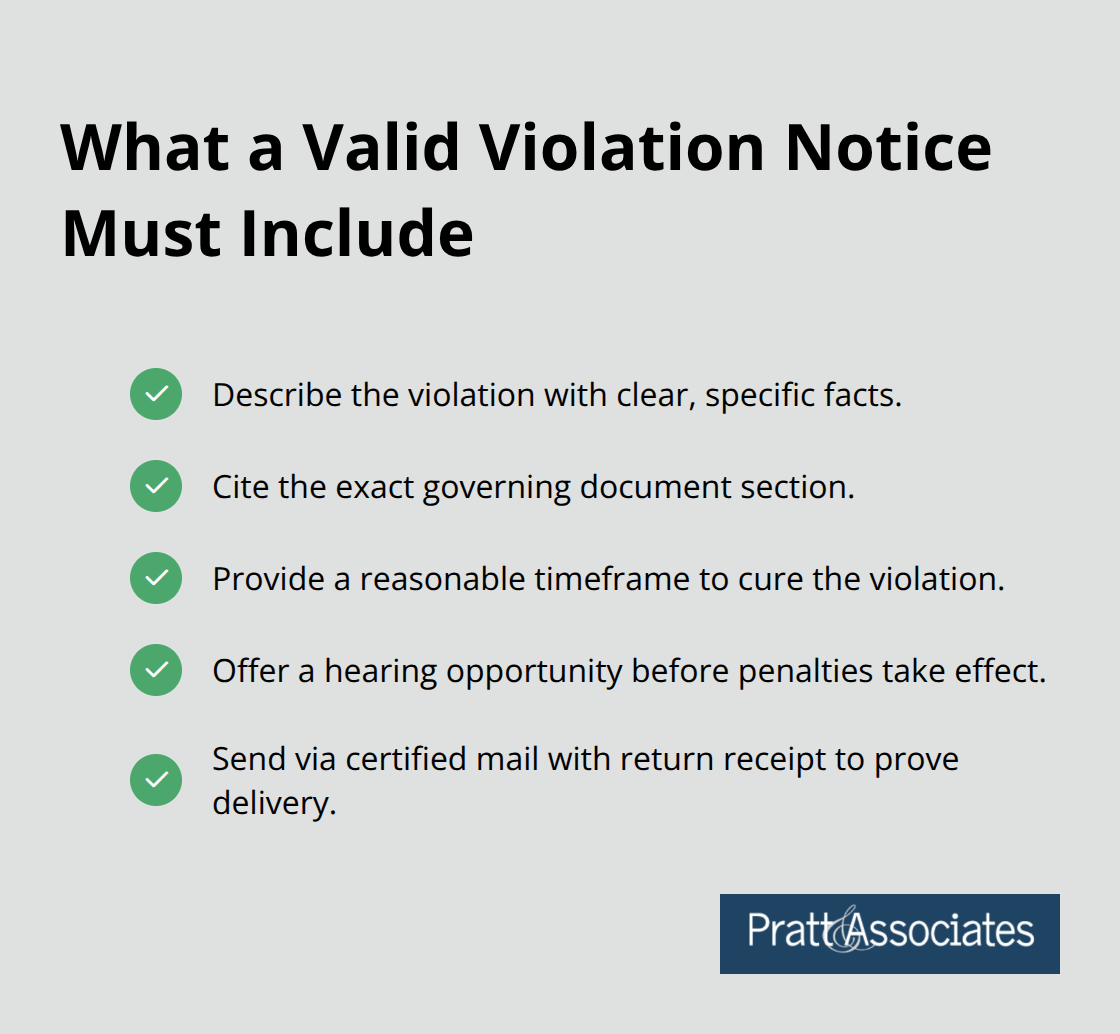
A violation notice stating only that a yard looks unkempt will fail in court; one stating that dead plants must be removed within 30 days per Section 4.2 of the CC&Rs creates enforceable documentation. Many residents respond positively to a clear notice because they now understand exactly what must change and by when. Sending the notice via certified mail with return receipt creates proof of delivery that protects the HOA if the resident later claims they never received it.
Fines and Special Assessments
When violations persist after the notice period expires, HOAs move to fines and special assessments. California Civil Code Section 1366 caps fines at $100 per day for most violations, though some violations carry different limits depending on their severity. The HOA must provide the resident with a hearing opportunity before the fine takes effect, and the resident can challenge both the violation and the amount.
After 30 days of unpaid fines, the HOA can record a lien against the property through a mechanical lien process. This creates serious financial consequences since the lien appears on title reports and prevents the owner from refinancing or selling without paying the debt. Santa Clara County properties with liens accumulate additional costs through recording fees and potential interest charges.
Liens: When Payment Becomes Mandatory
However, HOAs cannot immediately foreclose on liens for rule violations; California law requires a specific process and timeframe that varies based on the debt amount. The lien route should be the last resort after the HOA has genuinely attempted to work with the resident, because once a lien is recorded, legal costs and collection actions become inevitable.
When residents fail to pay fines and liens accumulate, the situation escalates beyond simple enforcement into formal legal territory. The next section examines what happens when voluntary compliance completely breaks down and HOAs must pursue court-based remedies to recover unpaid debts and restore community compliance.
When Court Involvement Becomes Necessary
Small Claims Court for Routine Violations
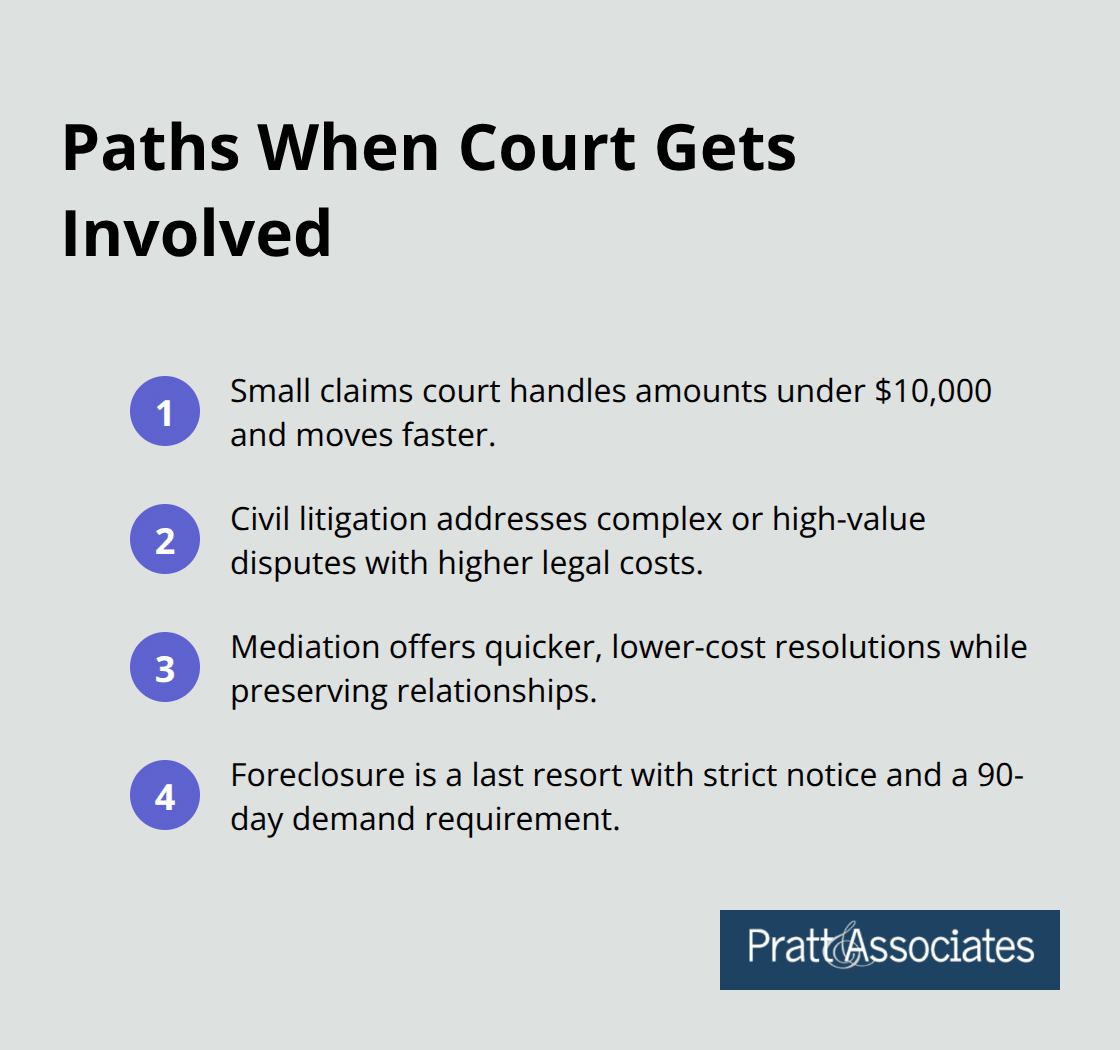
When residents ignore violation notices and liens accumulate without payment, Santa Clara County HOAs face a decision point: pursue formal legal action or accept the loss. Most boards choose to pursue collection because unpaid violations set a precedent that rules don’t matter. California Civil Code Section 1366.4 allows HOAs to collect unpaid assessments and fines through small claims court for amounts under $10,000, which covers the majority of enforcement disputes. Small claims offers a faster, less expensive route than standard litigation since neither side typically needs an attorney and hearings occur within weeks rather than months.
The filing fee in Santa Clara County runs approximately $30 to $100 depending on the claim amount, making it accessible even for modest violations. However, small claims judgments still require enforcement through wage garnishment or bank levies if residents refuse to pay voluntarily, so winning in court solves the legal problem but not always the collection problem.
Civil Litigation for Complex Cases
When violations exceed $10,000 or involve complex disputes about whether rules were properly enforced, standard civil litigation becomes necessary. These cases move slower and cost significantly more in attorney fees, typically ranging from $5,000 to $15,000 for straightforward collection actions in Santa Clara County. Courts evaluate whether the HOA followed proper notice procedures, whether the governing documents clearly prohibited the violation, and whether the fine amount complies with California caps.
A single procedural mistake-like failing to send the required preliminary notice or not providing a hearing opportunity-can invalidate the entire enforcement action and force the HOA to start over. Procedural compliance matters more than the merits of the violation itself in many cases.
Mediation as an Alternative Path
Mediation offers an alternative before litigation consumes resources; many Santa Clara County HOAs and residents settle disputes through neutral third-party mediators at a fraction of litigation costs. This approach preserves community relationships while resolving financial disputes more quickly than court proceedings.
Foreclosure: The Final Enforcement Tool
When foreclosure becomes the option, the stakes escalate dramatically since the HOA can potentially force a property sale to recover unpaid assessments, though California law imposes strict requirements including a 90-day payment demand and specific notice procedures that vary based on whether the debt exceeds $1,800. Foreclosure represents the most severe enforcement mechanism available to boards and should only occur after all other collection attempts have failed.
Final Thoughts
HOA enforcement procedures operate within strict legal boundaries that protect both boards and residents. The path from violation notice to court action follows specific steps, and skipping or mishandling any step can invalidate the entire enforcement effort. Boards that document rules clearly, communicate changes properly, and follow California’s notice requirements succeed in enforcement. Residents who understand their governing documents can avoid violations or respond appropriately when disputes arise.
The enforcement process escalates gradually by design-violation notices give residents a chance to correct problems without financial penalties, fines and liens apply only after residents ignore notices, and court involvement happens only when voluntary compliance completely fails. This progression gives everyone multiple opportunities to resolve issues before legal costs mount. A procedural mistake in how notice was delivered or how a hearing was conducted can destroy an otherwise valid enforcement action, which is why the technical details matter enormously.
When enforcement disputes arise, Pratt & Associates in Los Gatos handles real estate law matters including HOA disputes and property litigation. Their attorneys understand California’s HOA regulations and can guide boards through enforcement procedures or help residents challenge improper enforcement actions. Whether you’re a board member implementing rules or a resident facing enforcement, legal guidance prevents costly mistakes.