

California HOA law basics matter because board members and homeowners often operate without understanding their legal obligations. Misunderstandings about bylaws, financial requirements, and enforcement rules create costly disputes.
We at Pratt & Associates have seen how clarity on these core principles prevents problems before they start. This guide walks through the legal framework, financial rules, and dispute options that shape HOA operations in California.
What Laws Actually Control Your HOA
California’s Davis-Stirling Act, codified in Civil Code sections 4000-6150, is the foundational legal framework that governs how your HOA operates. This isn’t optional guidance-it’s binding law that applies to every common-interest development in the state, regardless of when the development was created. The Act underwent significant rewriting in 2014 and reorganized the entire regulatory structure, so even older associations must comply with current provisions. Federal law sits at the top of the hierarchy, followed by California state law, then your HOA’s CC&Rs and Bylaws. This means if your CC&Rs conflict with state law, state law wins.
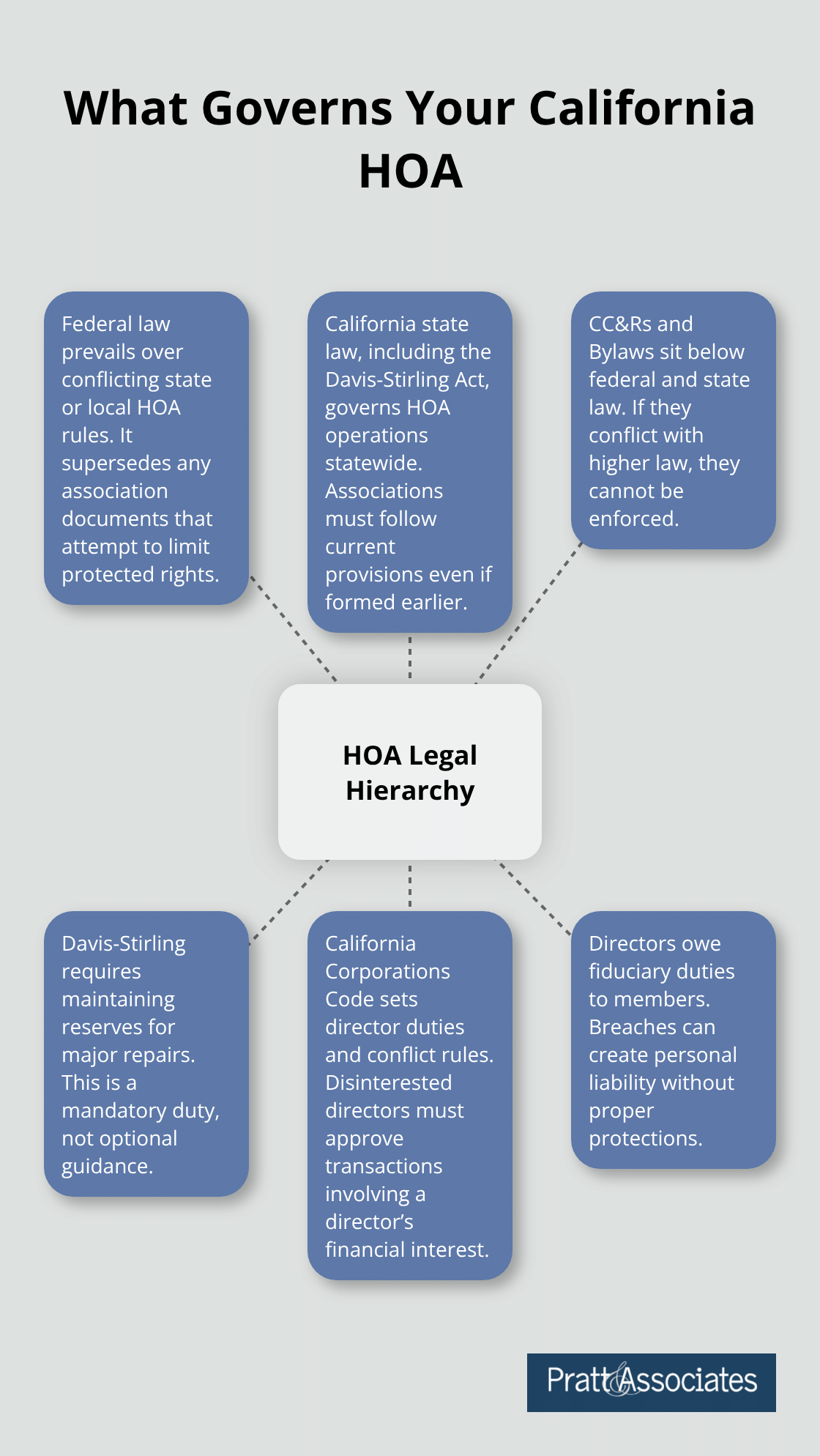
Understanding this hierarchy prevents boards from enforcing rules that violate higher legal standards. The Davis-Stirling Act specifically requires associations to maintain reserves for major repairs-not as a suggestion, but as a mandatory duty. California Corporations Code sections also apply to incorporated associations, adding requirements around director duties, conflicts of interest, and member voting rights. Most HOAs operate as nonprofit mutual-benefit corporations, which means directors owe fiduciary duties to the association and its members. Violating these duties can result in personal liability for board members, so taking this obligation seriously matters more than many boards realize.
CC&Rs Bind Every Homeowner
Your CC&Rs are the only HOA documents recorded with the County Recorder and legally bind every homeowner from the moment of title transfer. They establish use restrictions, assessment authority, and the association’s enforcement powers. Bylaws, by contrast, are never recorded and focus on operational details like meeting procedures, voting mechanics, and officer responsibilities. CC&Rs generally take precedence over conflicting Bylaws or Rules and Regulations. Amending CC&Rs requires a formal process outlined in Civil Code section 4705, typically demanding approval by a supermajority of members-often 66.7% or higher depending on your documents. This high threshold exists because CC&Rs affect property rights permanently. Rules and Regulations adopted by the board can address day-to-day conduct and common-area use, but they cannot override CC&Rs and must be distributed to all owners before enforcement. Many enforcement disputes arise because boards try to enforce rules that either contradict CC&Rs or were never properly distributed. If your association hasn’t reviewed its CC&Rs in the last five to ten years, you likely have compliance gaps with current state law requirements around short-term rentals, accessory dwelling units, and satellite dishes.
Directors Must Act Without Personal Conflict
Directors must act in the association’s best interest, not their personal interests, and cannot vote on matters where they have a financial conflict without full disclosure and board approval. California Corporations Code section 310 requires disinterested directors to approve any transaction involving a director’s material financial interest. Section 315 addresses loans or guarantees to officers, which generally require member approval unless your bylaws allow the board to decide without counting the interested director’s vote. The treasurer bears specific responsibility for preparing accurate annual budgets and financial statements delivered to members in compliance with Civil Code requirements. Board minutes must remain complete and accessible to members within approximately 30 days of each meeting. Open Meeting Act provisions in Civil Code sections 4900-4955 mandate that members can attend board meetings with at least four days’ notice. Boards that hold closed sessions without proper statutory authority face legal exposure. Directors and officers can obtain indemnification coverage to protect against personal liability when acting on behalf of the association, but this requires proper board or member approval and cannot cover intentional misconduct. Many boards operate without understanding that their personal assets can be at risk if they breach fiduciary duties or violate state law.
Financial Accountability Shapes Board Operations
The treasurer’s role extends beyond simple bookkeeping-this position carries legal weight under state law. Accurate annual budgets and financial statements must reach members in compliance with Civil Code requirements, and the treasurer prepares these documents. Board minutes must remain complete and accessible to members within approximately 30 days of each meeting. Open Meeting Act provisions in Civil Code sections 4900-4955 mandate that members can attend board meetings with at least four days’ notice. Boards that hold closed sessions without proper statutory authority face legal exposure. The association must maintain adequate liability and hazard insurance on property owned by the association, and the board bears responsibility for obtaining and maintaining these protections. Assessment collection and enforcement directly impact the association’s financial health, and boards must follow proper procedures when assessments become delinquent. Understanding these financial duties prevents boards from making decisions that expose the association to liability or create member disputes.
How Boards Build Budgets That Pass Legal Muster
The Legal Budget Requirement
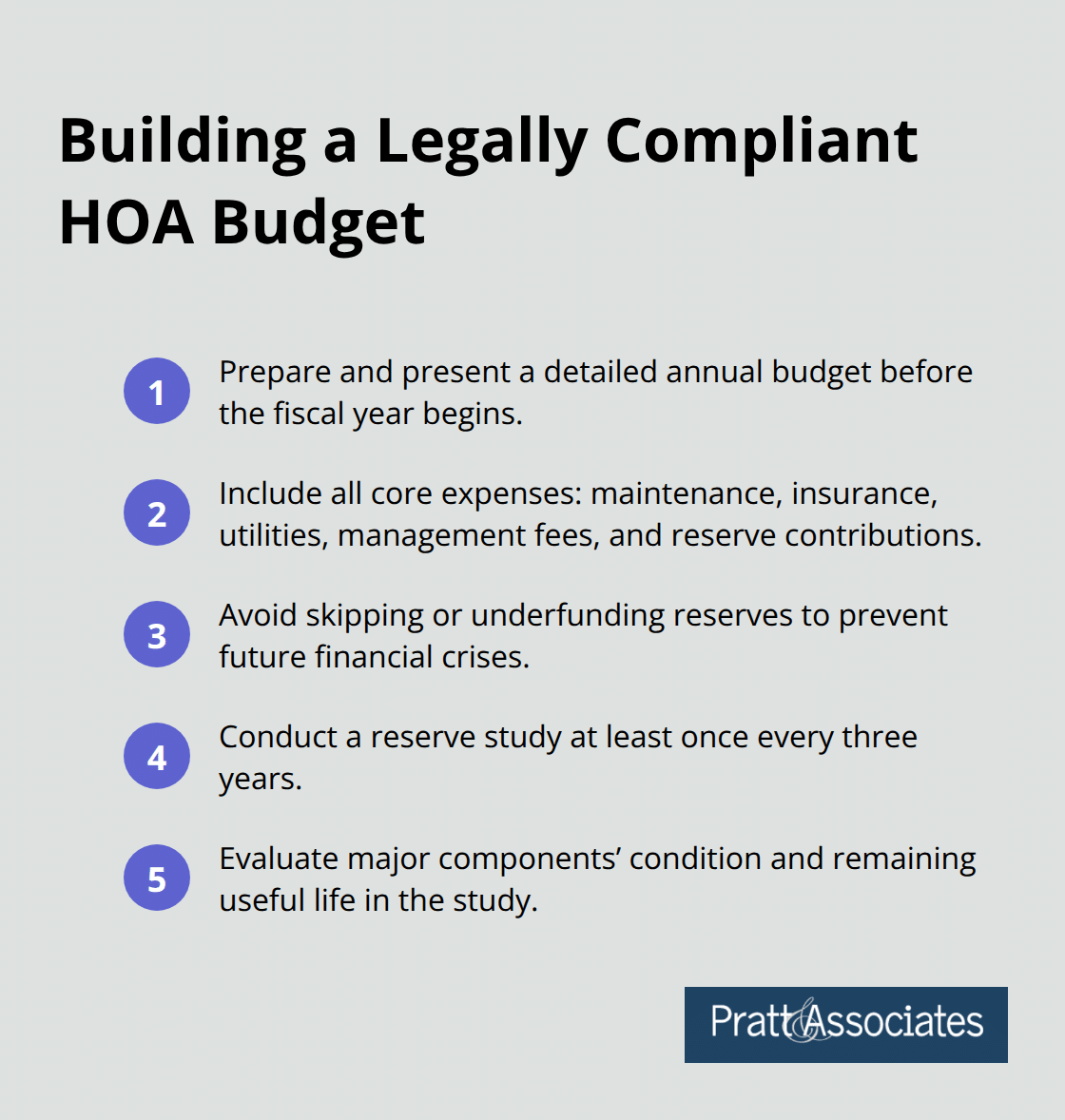
California Civil Code requires the treasurer to prepare a detailed annual budget and present it to members before the fiscal year begins. The budget must account for all anticipated expenses, including common-area maintenance, insurance, utilities, management fees, and most importantly, reserve contributions. Many boards skip reserve funding or underfund it dramatically, which creates massive problems later. California law mandates that associations conduct a reserve study at least once every three years, and the study must evaluate the condition and remaining useful life of major components like roofs, pavement, and exterior structures.
Reserve Funding Isn’t Optional
The reserve funding calculation is a legal requirement, not a suggestion. If your reserve study shows you need $500,000 over the next thirty years for roof replacement, your budget must reflect contributions toward that obligation. Boards that ignore reserve studies expose themselves to special assessments that anger owners and invite litigation. The assessment procedure follows a specific timeline outlined in your CC&Rs and bylaws, which typically set the assessment amount. If the board needs to increase assessments beyond what documents allow, member approval becomes necessary.
Separating and Managing Assessment Accounts
When assessments are collected, the association must maintain separate accounts for operating funds and reserves. Mixing these accounts or using reserve money for operating expenses violates fiduciary duty and state law. The treasurer must reconcile accounts monthly and present financial statements to the board showing exactly where money sits and where it’s going. If your association hasn’t had an independent audit in the last two years, that’s a red flag. Associations with annual revenues exceeding $250,000 should conduct audits or, at minimum, reviews by qualified accountants.
Transparency as a Governance Tool
Member access to financial records isn’t a courtesy-it’s a legal right under the Open Meeting Act and Civil Code sections 4900-4955. Owners can request copies of minutes, budgets, financial statements, and reserve study reports, and the association must provide them within roughly thirty days. Boards that delay or refuse member requests face legal exposure and member complaints. Transparency builds trust and reduces disputes. When members understand how their assessment money gets spent, they’re less likely to challenge board decisions.
Post your annual budget on a member portal or distribute it electronically so owners can review it without asking. Include a written summary explaining major expense categories and why reserve contributions matter. Many boards treat financial transparency as burdensome compliance rather than a governance tool that prevents conflict. That approach is backwards. Transparent financial practices demonstrate competence and reduce the likelihood of member lawsuits challenging board decisions.
Building Accountability Through Committee Structure
Boards should establish a finance committee with at least one director and knowledgeable members to oversee budget development, monitor spending, and ensure compliance with reserve funding requirements. This committee structure distributes responsibility and creates accountability. Quarterly financial reports to the membership keep everyone informed and reduce surprises. When a special assessment becomes necessary because reserves were neglected, members already know the problem exists because they’ve seen regular financial updates. That context prevents the shock and anger that typically fuel legal challenges. With solid financial practices in place, boards can move forward to address how rules actually get enforced and what happens when owners violate them.
When Disputes Arise Between Boards and Owners
Architectural Review Requires Clear Standards and Consistent Application
Architectural review requests and modification approvals consume significant board time, yet many boards handle them without clear procedures. California law doesn’t mandate specific architectural standards, but your CC&Rs almost certainly do. When an owner wants to paint their front door a non-approved color or install solar panels, the board must apply the standards written in the CC&Rs consistently. If your documents say exterior modifications need approval and the board approves one owner’s satellite dish but denies another’s identical installation, you’ve created a discrimination claim.
The Davis-Stirling Act prohibits arbitrary enforcement, meaning the board must document its decision criteria and apply them uniformly. Create a written architectural review policy that explains what requires approval, what standards the board uses to evaluate requests, and how long the review process takes. Most associations should respond to modification requests within 30 days or face liability for unreasonable delays. If the board denies a request, provide the owner written reasons tied to specific CC&R provisions. Vague denials like “this doesn’t fit our community standards” invite legal challenges.
Federal Law Overrides Local Restrictions
When federal law applies, such as FCC satellite dish rules or fair housing accommodations for disabled residents, those requirements override local restrictions. An owner requesting a satellite dish can cite FCC regulations that limit HOA restrictions, and the board must approve compliant installations regardless of CC&R language. Similarly, an owner needing a ramp for wheelchair access may qualify for reasonable accommodation under the Fair Housing Act, and the board cannot deny that modification based on architectural guidelines.
Rule Enforcement Demands Proper Notice and Hearings
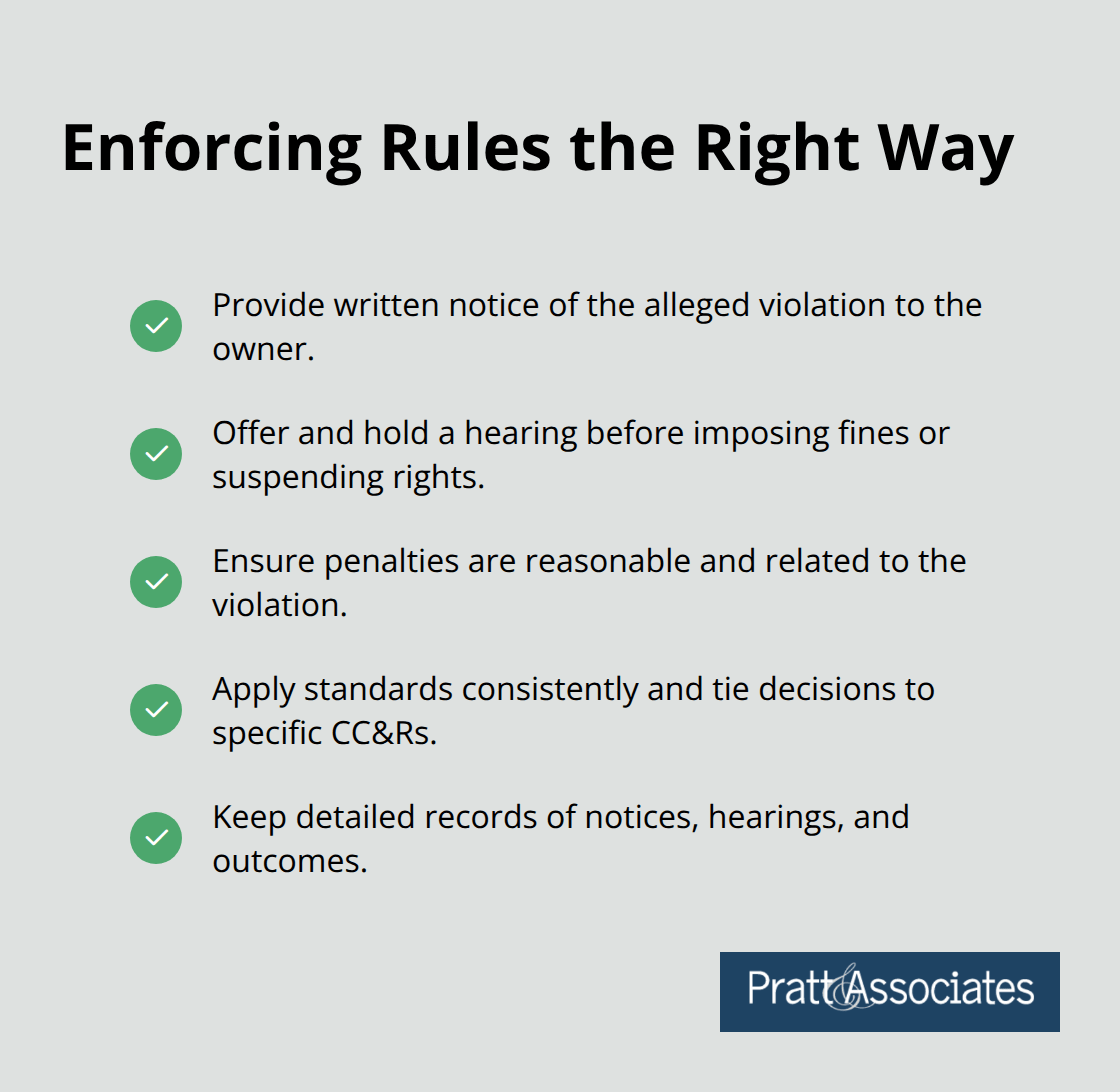
Rule enforcement and fines create the most litigation in HOA disputes. The board can adopt and enforce Rules and Regulations that govern common-area use and member conduct, but rules must align with CC&Rs and cannot discriminate among owners. Critically, rules must reach all owners before the board can enforce them. If an owner violates a rule they never received, the enforcement action fails. Document every rule distribution and keep proof that members received notice.
When an owner violates a rule, the board cannot immediately impose a fine without providing notice and an opportunity to be heard. Civil Code sections 4900-4955 require that before suspending voting rights or recreational facility access for delinquent assessments or rule violations, the board must hold a hearing where the owner can respond. Boards that fine owners without this hearing process face legal liability and have the fines overturned. The penalty must also be reasonably related to the violation and the association’s purposes.
A $1,000 fine for leaving a trash can visible overnight is excessive and likely unenforceable, while a $50 fine for the same violation passes the reasonableness test.
Keep written records of every violation, notice sent, hearing held, and fine imposed. When disputes escalate, these records determine whether your enforcement action survives challenge.
Mediation and Litigation as Resolution Paths
Mediation offers a practical alternative to litigation and costs a fraction of what lawsuits consume. California encourages HOA disputes to proceed through mediation before litigation, and many associations find that a neutral third party helps owners and boards reach agreement on architectural disputes or enforcement disagreements. Litigation should be the final option after other resolution attempts fail, not the first response to conflict.
Final Thoughts
California HOA law basics rest on three pillars: understanding your legal framework, managing finances with transparency, and resolving disputes before they escalate. The Davis-Stirling Act governs every aspect of your HOA, from reserve funding to rule enforcement, and federal law sits above state law, which sits above your CC&Rs and Bylaws. Directors owe fiduciary duties to the association and its members, meaning personal liability follows when those duties get breached.
Financial management determines whether your association thrives or struggles, since reserve funding is a legal requirement backed by mandatory reserve studies every three years. Separate operating accounts from reserve accounts, maintain complete and accessible records, and provide members with regular financial updates so transparency prevents disputes and builds trust. When members understand how their assessment money gets spent, they support board decisions rather than challenge them.
Enforcement requires clear procedures and consistent application across all owners, and architectural review requests need written standards applied uniformly to everyone. Rule violations demand proper notice and hearings before fines get imposed, while federal law overrides local restrictions when satellite dishes, fair housing accommodations, or other protected interests are involved. When questions arise about specific situations, contact Pratt & Associates for guidance tailored to your association’s circumstances.